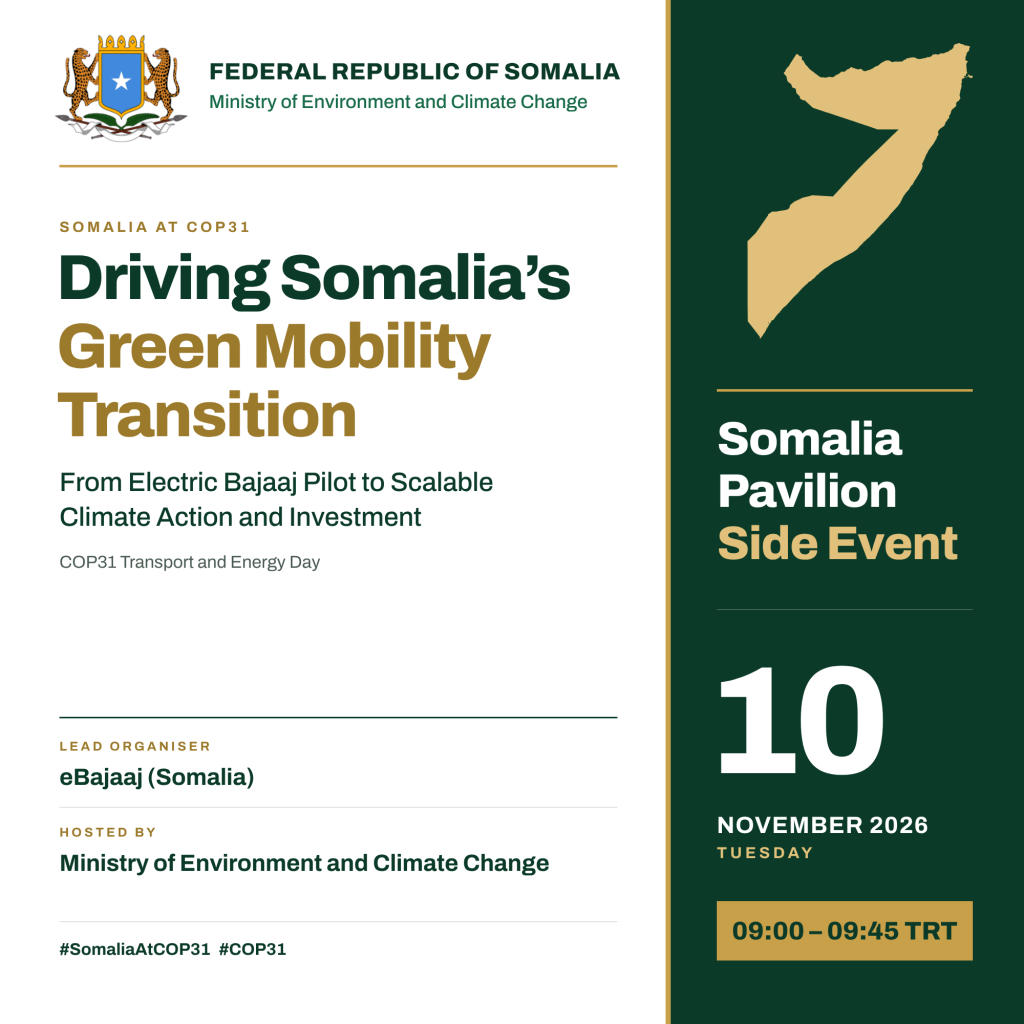
Driving Somalia’s Green Mobility Transition: From Electric Bajaaj Pilot to Scalable Climate Action and Investment
10 November 2026 · 14:40–15:40 (TRT) · Somalia Pavilion, COP31, Antalya, Türkiye
In June 2025 Somalia became the first country in East Africa to submit its NDC 3.0. The NDC puts its transport emissions at a baseline of 1.4 million tonnes of CO2 equivalent in 2024, rising to 2.1 million tonnes by 2035 under business as usual, and sets a 2035 target of 1.5 million tonnes, a 33 percent cut against business as usual. Its three transport actions are cleaner fuels, electric and energy-efficient vehicles (tuk tuks) and better public transport, and its costing includes 5,000 electric tuk tuks. Mogadishu has about 37,000 bajaajs, three-wheeled taxis that are the city’s main means of transport and a livelihood for tens of thousands of households. The fleet is entirely two-stroke, and fuel takes about 37 percent of a driver’s takings.
eBajaaj is a Somali programme that retrofits existing two-stroke bajaajs to electric drive with swappable lithium iron phosphate batteries, charged at solar-powered stations. It starts with a pilot of 20 vehicles and aims for 5,000 by Year 4. An independent environmental and social impact assessment has been completed, and its ratings stay preliminary until the pilot closes the remaining verification items. On the assessment’s modelled results, each retrofitted vehicle avoids about 3.7 tonnes of CO2 a year with solar charging, a driver keeps about USD 1,950 a year of fuel spend, and replacing the whole fleet would deliver roughly a fifth of the NDC’s transport reduction.
Lead organiser: eBajaaj (Somalia)
Hosted by: Ministry of Environment and Climate Change (MoECC)